
Design & Styling
How to decorate a shaded front porch with real and faux plants
Quick Answer
Ferns, hostas, begonias, and impatiens will grow in full shade, but they are a specific look, and a covered porch gets no rain so every drop is on you. If those plants do not suit the style you are after, faux is the honest answer. Look for matte leaves, mixed green tones, and an outdoor rating.
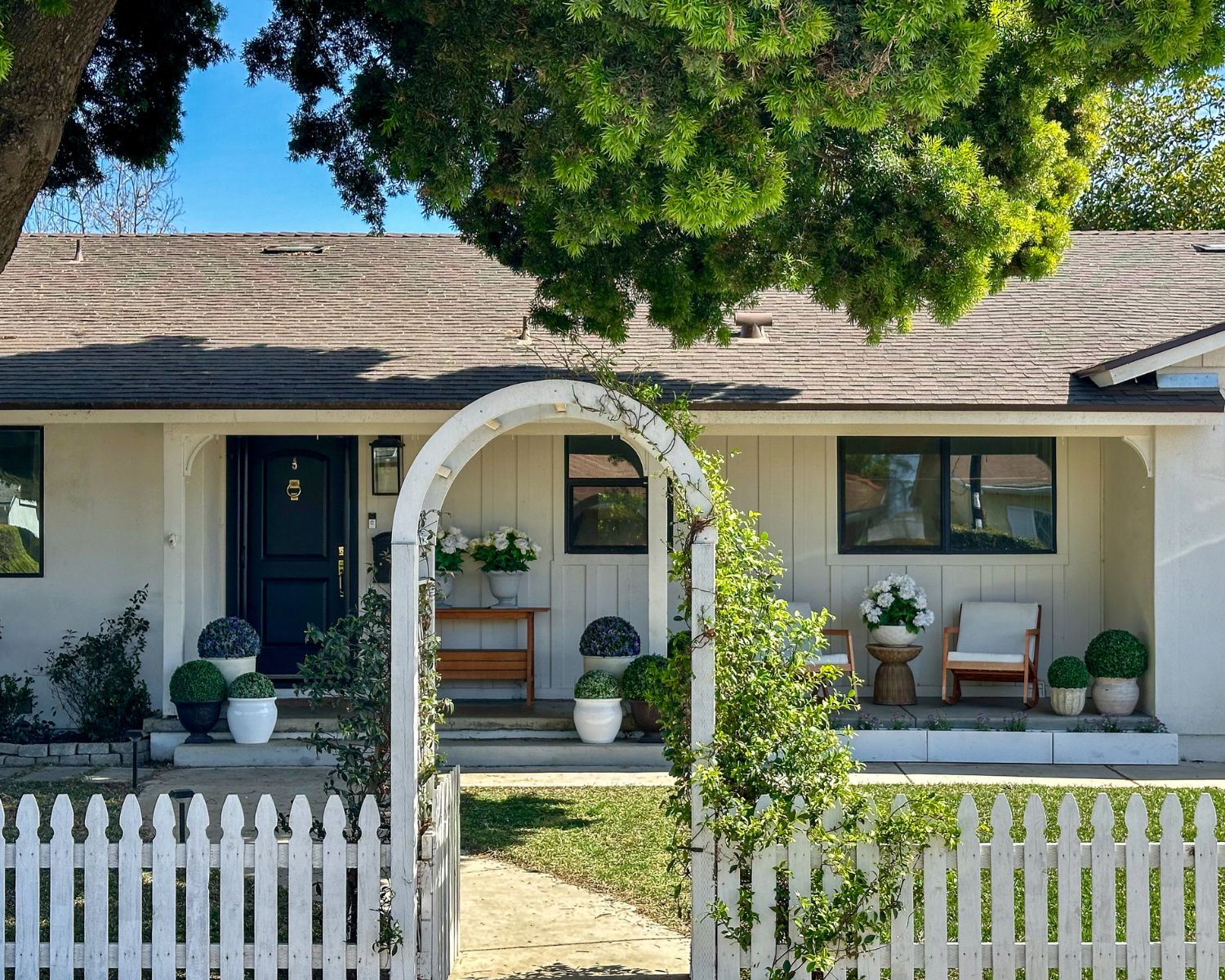
Our front porch is west facing, which sounds like it should be flooded with light. It is not. We have a low porch roof and an enormous tree in the front yard, and between the two of them the porch sits in shade all day, right up until the last few hours before sunset. Then it gets full, direct, late afternoon sun. For a few seasons I kept buying plants for it that were never going to work there.
The look I am after in this house is specific. It is a California ranch, and I have been slowly pushing it toward something Montecito-inspired, that warm, unhurried Nancy Meyers kind of ease. Clipped boxwood. White hydrangeas. Olive. A lot of green, with a lot of structure. Almost every plant on that list wants sun.
What full shade gives you instead is a different vocabulary entirely. Ferns, hostas, impatiens. Genuinely beautiful plants, and completely wrong for what I was building here. So the problem was never really that I could not keep things alive. It was that I kept trying to force a look onto a spot that could not support it.
Which bothered me more than it probably should have, because I am particular about this house. I have worked through the inside of it down to the cabinet hardware on the kitchen doors. And then there was the porch, the one thing every single person sees before anything else, and it was the part I could not get right.
Here is how I finally solved it, including the real plants that genuinely will grow in full shade if that look suits your house better than it suited mine.
Why won't plants grow on a covered porch?
A covered porch is a harder growing environment than it looks. The roof that makes it a nice place to sit is also blocking two things a plant needs.
The first is light. Most covered porches sit in full shade, which in plant terms means under four hours of direct sun a day, and a north-facing porch with a deep overhang can get almost none. The second is water. Rain does not reach under a roof. Every drop of water those pots get has to come from you, on a schedule, forever.
There is a third condition that is easy to miss, and it is the one that had me beaten for a while. A porch is not always shaded evenly. Ours is dark all day and then takes direct western sun for the last few hours before sunset, which is the hottest, harshest light of the day. That combination is worse than steady shade. Shade-loving plants scorch in that late window, and sun-loving plants cannot live on two or three hours. If nothing you plant survives and you cannot work out why, watch where the light actually falls across a whole day before you buy anything else.
So the plant has to tolerate deep shade and survive on your memory. That is a narrow list, and it gets narrower when you add a third requirement that nobody at the garden center asks about, which is whether you actually like how it looks. Most plants that genuinely thrive in full shade are foliage plants, because flowers take a lot of sun energy to produce. Ferns, hostas, ivy. They are lovely plants. They were not the look I wanted at my front door.
That is the part I want to be honest about, because most articles on this topic hand you a list of shade-tolerant plants and stop there. If you have already tried that list and watched it fail, the problem is not that you picked the wrong fern. The problem is that your porch is not a growing space, and you have been treating it like one.

What real plants actually grow on a shady porch?
Before I talk about faux anything, let me give you the real answer, because if you can pull this off you should.
There genuinely are plants that grow in full shade. The catch is that most of them are grown for their leaves rather than their flowers, because blooming takes sun energy a covered porch does not have. Once you make peace with that, the list is better than people expect.
- Ferns — The classic shady porch plant for a reason. Boston ferns in hanging baskets, Japanese painted ferns in pots for something with more silver in the leaf. They want to stay moist and stay out of direct sun.
- Hostas — Usually planted in the ground, but a single hosta in a container is beautiful and it comes back every year. Give it room, because some varieties spread two to three feet wide.
- Begonias — One of the few things that will actually flower for you in shade. Wax begonias bloom all summer and tolerate a wider range of light. Tuberous begonias have bigger leaves and bigger flowers and are stunning in a hanging basket. Both bloom more generously with a couple of hours of dappled light.
- Impatiens — The answer you get at every garden center, and there is a reason. They prefer full shade, will take a little morning sun, and flower for months.
- Coral bells — Grown for foliage rather than flowers, in deep burgundy, chartreuse, silver, and near-black. Good for adding color where nothing will bloom.
- Torenia — Also called wishbone flower, and the most underused plant on this list. Small snapdragon-like blooms that keep going in genuinely deep shade.
- Caladium — Heart-shaped leaves in pink, white, and green that light up a dark corner. One note if you have pets, and I do: caladium is toxic to cats and dogs. It sits on my list of plants I will not put at my own front door.
One useful thing about shade containers is that they dry out more slowly than pots in full sun. That is the good news. The bad news, and the part that got me, is that a covered porch gets no rain at all, so slower is still not never. Every drop those pots receive has to come from you.
Should you use faux plants on a covered porch?
Here is where I have to be honest with you.
Nothing beats a real plant. A living fern has movement and depth and irregularity that no manufactured thing has ever fully copied. If you can keep real plants alive on your porch, do that. This section is not an argument that faux is better.
It is an argument that faux beats the wrong plant.
On my porch, the plants that would thrive and the plants that give me the look I want are two separate lists, and they do not overlap. I could have a healthy fern beside my front door, or I could have the clipped green structure I actually wanted. Not both. Every time I chose the look, I was buying something for a spot that could not sustain it, and I have killed my share of plants over the years learning that lesson the expensive way.
So at some point the question stopped being which shade plant I could keep alive, and became how to get the look I wanted in a place that was never going to grow it. Faux was the answer. A well-chosen faux boxwood does the exact job I needed done, all year, without asking my porch to be something it is not.
So I found faux shrubs at HomeGoods one spring, put them in the planters on the dark side of the porch, and nobody has noticed since. Not visitors, not neighbors, not the delivery driver. They read as green, healthy, well-kept plants, which is the entire job they were hired to do.
There is a reasonable version of this and an unreasonable version. The unreasonable version is filling your whole yard with plastic. The reasonable version is recognizing that a covered porch is closer to an interior room than a garden bed, and styling it the way you would style a room, using the same basic design principles you would use inside. You would not feel bad about a beautiful piece of art on a wall that gets no sun.
The practical case holds up too. Faux plants look identical in February and August. They do not need watering when you go out of town. And on a per-year basis they usually cost less than replacing annuals every season, which is exactly what I was doing. It is the same math I use when I am setting a renovation budget: spend once on the thing you would otherwise keep re-buying.
How do you pick faux plants that don't look fake?
This is the whole thing. A good faux plant is invisible and a bad one is the first thing you see. Four things separate them, and the first three are all about realism, because on a shaded porch that is what you are actually buying.
- A matte finish — Shine is what gives fake plants away. Real leaves have some sheen but they scatter light unevenly. Injection-molded plastic reflects it in a hard, uniform way that your eye clocks instantly, even from the sidewalk. Tilt it toward a window before you buy. If it glares, put it back.
- Mixed green tones — A real boxwood is not one color. It has yellow-green new growth, deeper green mature leaves, and some brown woody stem showing through. Cheap faux plants are molded in a single flat green. The better ones vary the tone across the plant, and that variation is most of what sells it.
- Believable scale — Real plants grow in proportion to their root space. A faux shrub the size of a beach ball sitting in a twelve-inch pot reads as wrong before you consciously know why. Match the plant to the pot the way nature would, and lean smaller rather than larger.
- Outdoor rated — This is the durability one, and it matters for reasons that have nothing to do with sun. A covered porch is still outdoors. Wind pulls at stems, blowing rain gets into the joints, and cold makes cheap plastic brittle until pieces snap off. Indoor faux plants are not built for any of that, and plenty of the prettiest ones online are indoor plants. If the listing does not say outdoor, assume indoor.
Most outdoor-rated faux plants are also UV treated, which turned out to matter more here than I expected. A porch that is shaded all day still catches direct sun in that last stretch before sunset, and western light is the strongest of the day. Untreated faux plants go pale and chalky under it. The second reason is that I move mine around. A pair of boxwoods that live on the shaded porch in spring often end up flanking the back patio by summer, where they get real afternoon sun. UV treatment means I can move them wherever a space needs filling without worrying about it. If your porch truly never sees direct sun at any point in the day, this matters less. Mine does, and most do somewhere.
One more thing that helped me more than any of the above. Pick a species that genuinely grows where you live. Everything faux on our porch is boxwood, hydrangea, or white roses, and all three are plants people actually grow around here, so nothing reads as out of place. A faux tropical in a New England entryway does not have that advantage, no matter how well it is made.
Boxwood does most of the work, because it is the plant that carries the whole look I was after and it is the one I could never have grown in that spot. The hydrangeas live in the urn by the door, where a real one would have needed more light and far more water than that corner was ever going to give it. The white roses go where I want a little softness against all the clipped green.


What size planter should you use for faux shrubs?
I learned this one by accident, and it is the tip I would give first if I only got one.
I had a set of small green faux shrubs that I had been putting in large light-colored pots, and they looked wrong every single time. I could not name why. When I finally moved them into smaller dark brown containers, they looked completely convincing. The pot had been the problem the entire time, not the plant.
Two rules came out of that. The first is the proportion rule. A faux shrub should be roughly the same height as its planter, or a little taller, but never dwarfed by it. A small plant in a big pot reads as a plant that failed to grow, and your eye interprets that as unhealthy rather than fake, which is somehow worse.
The second is the color rule. A dark planter reads as soil and shadow, which is what your eye expects underneath a plant. A pale planter creates a hard bright line right where the stems disappear, and that line is where the illusion breaks. If you are using light-colored pots, and I do use them in plenty of places, fill the top with real dark soil or moss so the transition is not so abrupt.
How do you arrange front porch planters so they look intentional?
Symmetry, and I say that as someone with strong feelings about it.
The fastest way to make a porch look designed rather than accumulated is to give it a mirror line. Match what sits on the left of the door to what sits on the right. Same planters, same plants, same heights. This is why entrances with a matched pair of urns look formal and finished while entrances with four different pots look like storage. It is the same instinct that makes a room feel considered rather than collected, where balance is what keeps a mix from reading as clutter.
You do not need perfect symmetry across the whole porch. Mine is not symmetrical overall, because one side is shaded and one side gets light, and they hold different things. But each individual moment reads as balanced. The two urns flanking the door match each other. The pair of planters at the steps match each other. Within each pairing there is order, and that is enough for the whole thing to feel calm.
The other half of this is repetition. Using the same faux boxwood in three places around the porch looks intentional. Using three different faux plants looks like three separate shopping trips, which is exactly what it usually is.

What can you plant if part of your porch does get sun?
Here is where I stopped fighting my porch and started reading it.
One section of my porch sits directly under the tree and gets almost nothing until that late window. The other side, along the raised beds, sits past the tree line and picks up real afternoon sun. For years I treated the whole porch as one problem. It is not. It is two different light conditions that happen to share an address, and once I split them, both got easier.
The shaded section gets faux. The beds that get light get real flowers.
What I planted there is Aromance Mulberry, a nemesia from Proven Winners, and it has been one of my favorite plant discoveries in a long time. The flowers are a deep plum purple, they are genuinely fragrant, and they filled the beds in without any fuss.
A few specifics worth knowing before you buy it:
- Light — It wants part sun to sun, roughly four to six hours or more. This is not a full-shade plant, which is exactly why it belongs on the bright side of the porch and not the dark side.
- Size — It matures around ten to eighteen inches tall and twelve to eighteen inches wide, a good scale for a raised bed or a window box without swallowing it.
- Season — It is strongest in the cool months of spring and again in fall. In real heat, when night temperatures sit in the upper seventies, it can stop flowering. A light trim brings it back once things cool down. Worth knowing so you do not think you killed it in August.
- Maintenance — It is self-cleaning, so no deadheading. That matters to me more than I would like to admit.
- Zone — It is grown as an annual in most of the country, and holds on as a perennial in zones eight through ten.
The other real plant out here is star jasmine, growing up the trellis. It handles part shade, it stays green year round so the arbor never looks bare in winter, and when it blooms in spring you smell it from the sidewalk before you see it. If you have any vertical structure near a porch that gets a few hours of light, it is one of the easiest wins available.
If your sunny section is in deeper shade than mine, the honest answer is foliage rather than flowers. Ferns and hostas earn their reputation. But if you have four hours of light, you have more options than the shade lists suggest, and it is worth measuring before you assume.
How do you mix real and faux plants on one porch?
This is the move that pulled my whole porch together, and it is one line long.
Match the colors across the two sides.
The faux florals on my shaded side are purple. So when I went looking for real flowers for the sunny beds, I looked for purple, which is how I ended up with the plum-colored nemesia. Now someone standing at the curb sees one porch with a consistent palette, not a real half and a fake half. The color does the work that the plants cannot.
The same logic applies to your planters, your cushions, and anything else out there. Pick a palette of two or three colors and hold the line. My porch is white, warm wood, deep green, and purple. Nothing else gets in. The warm wood out here is the same walnut tone I used on the kitchen shelves inside, which is not an accident. When everything shares a palette, the eye stops auditing individual objects and reads the whole thing as designed.
This is also why matching your planters matters more than it seems like it should, and it is the piece I am still finishing on my own porch. Mine came from different places over several years, and they are different colors, and it bugs me every time I look at them. The fix is straightforward. Clean them, prime anything glossy, and spray them all one color in an outdoor-rated paint. One afternoon of work turns a collection into a set. Mine are still not done, and I will update this post when they are.
Shop the look
The faux boxwood, urns, and planters on our porch, plus the pieces I keep coming back to for the rest of the house.
Faux porch plant FAQ
Are faux plants better than real plants for a porch?
No. A real plant has movement and depth that no faux version fully matches, and if you can keep real plants alive on a covered porch, that is the better outcome. Faux plants win in one specific situation, which is when the alternative is dead plants. A covered porch gets no rain and often under four hours of light, so it demands consistent hand watering. If that has not worked for you before, faux is the honest choice.
What is the difference between indoor and outdoor faux plants?
Outdoor faux plants are built for weather, not just sun. They use heavier stems and tighter joints so wind does not pull them apart, materials that shed blowing rain, and plastics that stay flexible in cold instead of turning brittle. Most are UV treated as well. A covered porch is still outdoors, so an indoor faux plant will degrade there even without direct sun.
Do faux outdoor plants fade in the sun?
Untreated ones fade quickly, sometimes within a single season. UV-treated ones hold their color far longer. On a permanently shaded porch this matters less, since there is no direct sun to fade them. It matters a lot the moment you move a plant somewhere brighter, which is why buying outdoor rated is worth it even for a dark porch.
How do you clean faux outdoor plants?
Rinse them with a hose every few weeks and let them air dry. For a deeper clean, wipe the leaves with a damp cloth and a drop of dish soap. Dust is the main thing that makes faux plants look fake over time, because real leaves get rinsed by rain and porch plants never do.
What is the best faux plant for a front porch?
Faux boxwood is the most versatile, because boxwood grows almost everywhere and reads as plausible in nearly any region and any style of home. Faux hydrangeas work well in an urn or a large pot where you want flowers, and faux white roses are good for softening a lot of clipped green. Avoid anything tropical unless you actually live somewhere tropical.
Can you leave faux plants outside in winter?
Most outdoor-rated faux plants handle cold fine. The bigger risks are wind and snow load, which can bend stems or blow lightweight pots over. Weight your planters with rocks or sand in the base, and bring smaller pieces in if you get heavy storms.