Hosting & Gatherings
How to make a charcuterie board that actually looks like the ones you save
By Liz Lovery · Last updated July 27, 2026
Quick Answer
A charcuterie board is a wooden board arranged with cured meats, cheeses, fresh fruit, nuts, jams, and bread. Build it from seven categories, spread everything across the board instead of grouping it in one place, and fill the gaps with nuts and fruit. Plan on about two ounces each of meat and cheese per person.
Wanting to learn how to make a charcuterie board is one of those signs that you have reached the pinnacle of adulthood. It is up there with scheduling your own appointments, folding your laundry the same day you wash them, and realizing that you would rather stay in and watch Netflix on a Saturday night than go to a nightclub.
A charcuterie board is sophisticated (at least it sounds sophisticated), and making one will not only impress your guests next time you invite them over for dinner, but it will make you feel like the goddamn Queen of England. So, get your crowns ready because today I am going to teach you how to make a charcuterie board and the seven essential elements it should include for the perfect spread.
I have been building these for years now, for everything from a Tuesday night in to a full dinner party, and the formula has not really changed. Seven categories, one board that is bigger than you think you need, and a little patience with the arrangement. Everything below is exactly how I build mine, including the shopping list I actually use.
What is a charcuterie board?
Charcuterie, by definition, is a collection of cold cooked meats. The word charcuterie is a French term that translates to "cooked flesh," a little morbid, I know, but the reality is that cold cuts are delicious, especially the kind that is served on a charcuterie board. But what is a charcuterie board? Well, the charcuterie itself is typically served on a wooden board, like a cutting board or cheese board, along with a variety of breads, cheeses, spreads, and fruits. It is common, and expected, that you serve wine with a charcuterie board.
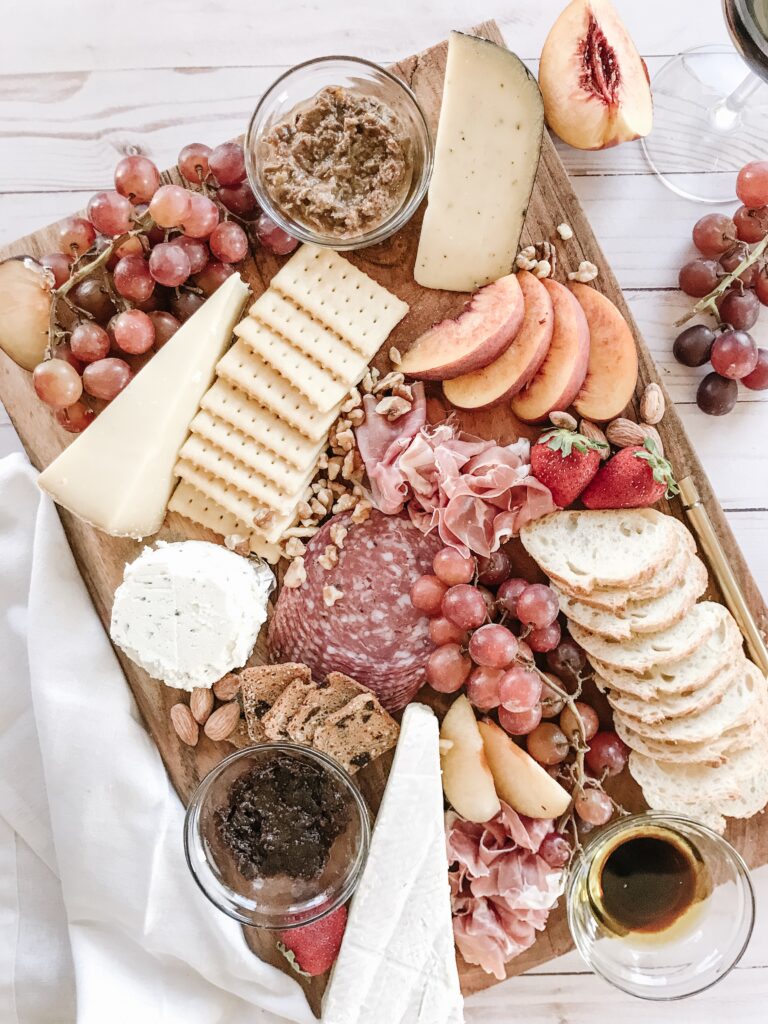
What separates a charcuterie board from a cheese plate is variety. A cheese plate is two or three cheeses and some crackers. A charcuterie board pulls from all seven categories below, which is what gives your guests something like forty different combinations to try instead of four. It is also the reason a board works as an entire evening rather than a first course. Set one out with a properly set table and you have a dinner party without turning on the oven.
What should you put on a charcuterie board?
There is no right or wrong answer when it comes to what to put on a charcuterie board, but if you want to go above and beyond, it should include a variety of choices from seven different categories.
1. Meat
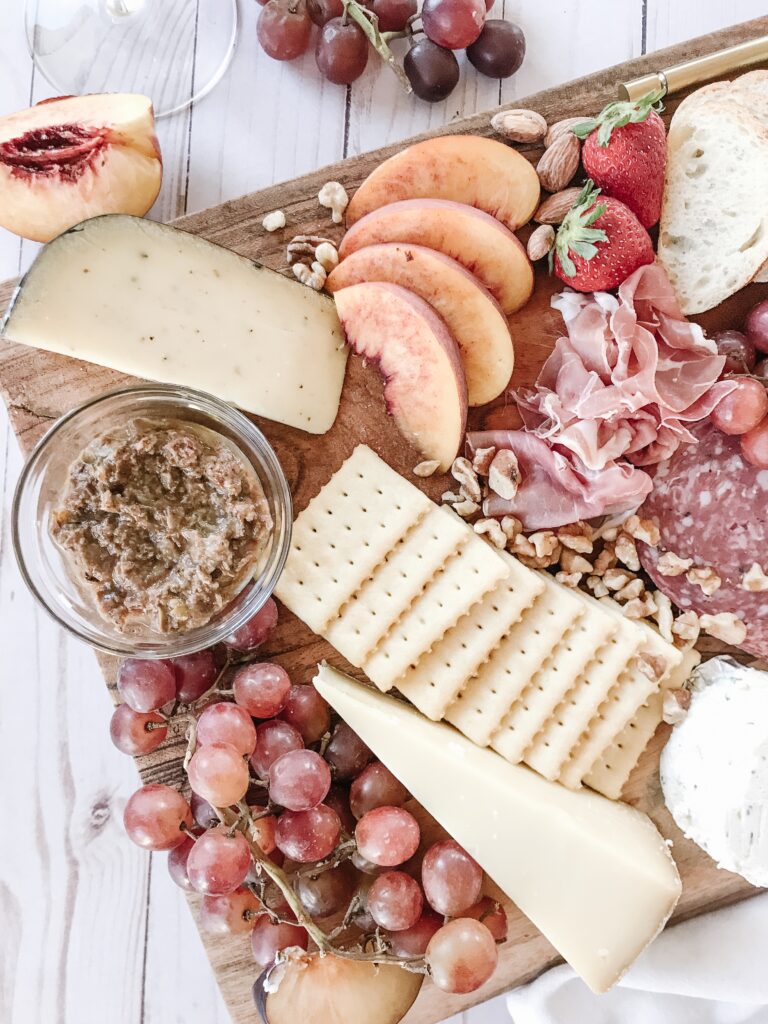
You cannot have charcuterie without the meat, and it is one of the most important elements of a good charcuterie board, in my opinion. The best meat to serve on a charcuterie board is some form of salami, I prefer peppered salami, and prosciutto. Prosciutto is an Italian dry-cured ham that is thinly sliced, which pairs perfectly with bread and cheese.
2. Cheese
Although it is called a charcuterie board, the meats are often overshadowed by the cheeses. It is easy to see why, though, cheese and wine are the perfect pair. But when it comes to making your charcuterie board, having a variety of cheese is a must. I use three to four different types of cheeses that will almost always include a light and creamy cheese like Brie, a rich and flavorful cheese like a Truffle Parrano, a sharp and hard cheese like cheddar, and a creamed and herb-infused cheese like a Gournay cheese.
The reason four works better than two is texture. Soft, semi-soft, hard, and spreadable all behave differently against the same cracker, and that is what keeps people going back to the board.
3. Fresh fruit
Incorporating a variety of fresh fruits is important because it gives your palate a break from the salty meats and cheese. Meat and cheese tend to be rich in flavor and the fresh fruit brings a different element to the mix. I recommend using an assortment of in-season fruits, but again, you cannot go wrong here. There are a few fruits, however, that I feel taste amazing with wine and charcuterie: peaches, plums, grapes, strawberries, and figs. These fruits are also super colorful and add a little something extra to your charcuterie board.
4. Nuts
I love adding nuts to my charcuterie spread. You do not need a lot but it does provide a warmer element to it and also adds a little extra protein. I usually will include whatever I have around the house and that is usually almonds and walnuts but you can add whatever nuts you like.
5. Jams and spreads
Okay, this is another must for me. I think fig jam is the best jam you can serve with a charcuterie board. It is not too fruity and it tastes soooooo so good with brie cheese. I highly recommend it. Similarly, I think an olive tapenade is a game changer. Tapenade is a mixture of olives, oils, anchovies, capers, garlic, herbs, and lemon juice. It is perfect for spreading on crackers. And you cannot forget about the honey! The honey adds just the right amount of sweetness and subtleness to the charcuterie without overpowering it. It might also be worth adding a little bit of balsamic vinegar and oil to the mix.
6. Bread and crackers
In France, a traditional charcuterie board is served with bread, not crackers. And I follow this rule, to an extent. I always serve a French baguette, sliced, as well as two different types of crackers. I love a good ol' butter cracker, especially with the tapenade. My go-to is the Club crackers by Keebler. I also like to add a dried fruit-infused cracker, like the Fig and Olive Crisps from Trader Joe's. This one is a unique option for mixing and matching the cheese and fruit jams.
7. Wine
And last, but certainly not least, if you want to know how to make a charcuterie board, you absolutely cannot forget about the wine. A charcuterie board was intended to be eaten with wine so a good wine is crucial. This charcuterie board will go great with red or white wine, however, I feel the richness of some of the ingredients are incredible with a robust red, such as cabernet or a pinot noir. I think using lighter fruit jams, like apricot or strawberry, will go great with white wine.
How much charcuterie do you need per person?
This is the question I get most often, and it is the one that keeps people from overspending. As an appetizer before dinner, plan on about two ounces of meat and two ounces of cheese per person. If the board is the whole meal, double both to roughly four ounces each and add more bread.
For a group of eight, that means about one pound of meat and one pound of cheese total, split across your two meats and your four cheese wedges. Everything else is generous by nature. One baguette, two boxes of crackers, a cup or so of nuts, and three to four kinds of fruit will comfortably cover the same eight people, and leftovers of those keep far better than sliced cheese does.
What kind of board should you use?
There are so many types of charcuterie boards out there and if you are in the market for one, I highly recommend ordering one that is larger than you anticipate you will need. I cannot tell you how many times I have purchased a charcuterie board only to realize it is just NOT big enough for all the things I want to add to it. I do not know about you, but for me, the presentation is KEY when it comes to making the perfect charcuterie board and I cringe at the thought of having all of my ingredients dispersed onto different plates or serving platters.
For sizing, a board around eighteen by twelve inches serves six to eight people as an appetizer. Twenty-four inches or larger is what you want if the board is dinner. Acacia, walnut, and olive wood all hold up well and none of them need more than a wipe with mineral oil every few months. A board with a handle or a slight lip is worth the extra money the first time you carry a fully loaded one across the house.
Shop the Boards
The wooden boards, small glass bowls, and cheese knives I actually use when I put one of these together.
How do you arrange a charcuterie board?
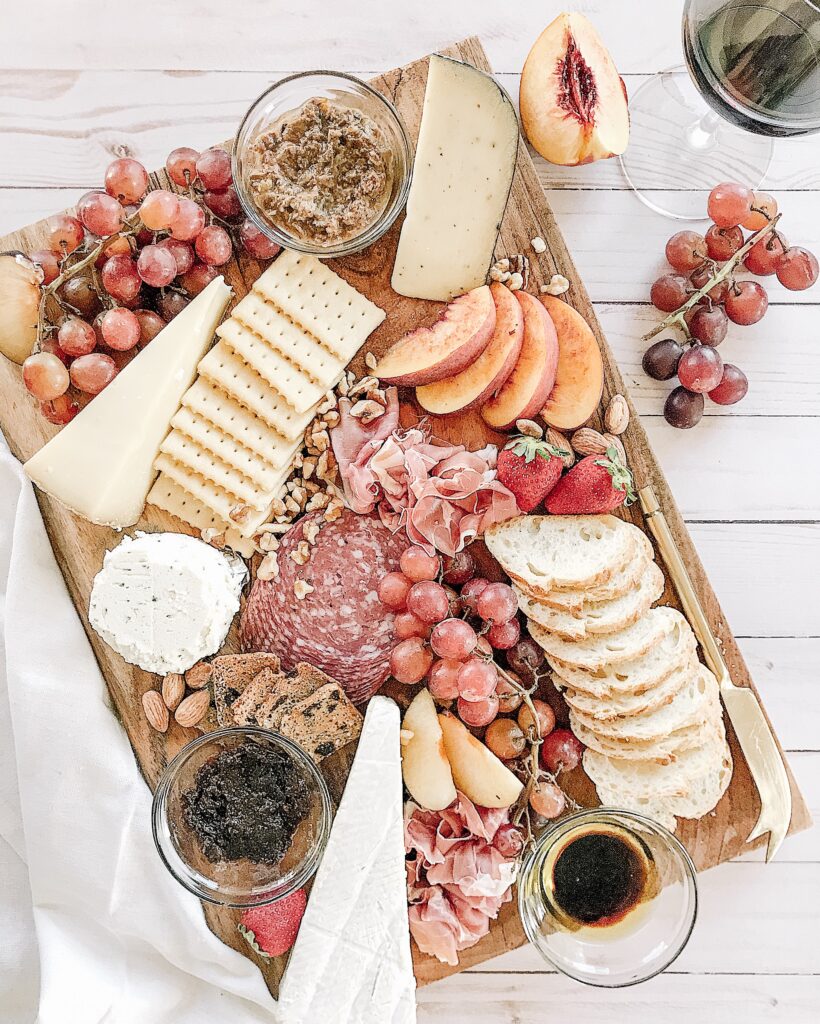
Arrangement is the part that makes a board look like the ones you save on Pinterest instead of a plate of groceries. The order matters, because the big rigid pieces have to go down before the small flexible ones. Here is how I build mine, every time.
- Place the cheeses first. Set your three or four cheese wedges down before anything else, spaced out across the board rather than clustered in one corner. They are the biggest, most rigid pieces, so everything else gets built around them.
- Add your bowls. Put the fig jam, olive tapenade, and honey into small glass bowls and nestle them into the open spaces between the cheeses. Bowls add height, and they keep the wet ingredients from running into the crackers.
- Lay in the meats. Fold or ruffle the prosciutto into loose piles and fan the peppered salami into overlapping rows. Give each meat two separate spots on the board instead of one big pile so guests are not reaching over each other.
- Build the cracker and bread lines. Run the club crackers and fig and olive crisps in long lines along the edges of the board, and fan the sliced baguette in an arc. Lines and arcs read as intentional, and they hold their shape as people take from them.
- Fill in with fresh fruit. Tuck the grapes, sliced peaches, plums, strawberries, and figs into the remaining open areas. Fruit is what makes the board look full and colorful, so save it for after the structural pieces are down.
- Fill the last gaps with nuts. Scatter the roasted almonds and walnuts into any bare wood that is still showing. This is the step that takes a board from good to finished, and it costs you about thirty seconds.
Three rules on top of that order. Mix it up. When it comes to the arrangement of everything, it is a good idea to distribute your food all over the board. For example, I do not recommend putting all of your cheeses or fruits or spreads in one area. I like to break it up and have a good mix of everything spread across the board.
Use smaller items to fill in gaps. Use the nuts and fruits to fill in any large gaps from bigger items. This not only looks good, but it also encourages your guests to try more items on the board.
Do not put everything on at once. Sometimes it is a good idea to introduce things onto the charcuterie board in waves, or in smaller increments. Charcuterie can be filling, and one of the best parts about enjoying a charcuterie board is just that, it is enjoying! Take your time and surprise your guests with more options as the night goes on.
How far in advance can you make a charcuterie board?
You can do most of it early, which is the whole reason a board is my favorite thing to serve when I am hosting. Assemble the cheeses, meats, nuts, and bowls of jam up to four hours ahead, cover the board loosely with plastic wrap, and put it in the refrigerator.
Hold back the crackers, the sliced baguette, and any cut fruit until about thirty minutes before people arrive. Crackers go soft against damp cheese and sliced peaches brown faster than you would think. Then take the whole board out of the refrigerator forty-five minutes before serving. Cold cheese tastes like almost nothing, and that gap between refrigerator temperature and room temperature is the single biggest difference between a good board and a flat one.
If you are carrying the board somewhere, build it in a shallow dish with a lid rather than on the wood, and transfer it once you arrive. That is the same trick I use for a beach picnic spread, and it saves you from rearranging everything in a parking lot.
What wine goes with a charcuterie board?
A robust red is the safest single bottle. Cabernet sauvignon or pinot noir both stand up to the salt in the prosciutto and the sharpness of an aged cheddar without getting lost. If you are leaning on lighter fruit jams like apricot or strawberry, a crisp white is the better match, and a dry rose splits the difference nicely in warm weather.
Put out one red and one white and you have covered every guest at the table without thinking about it. And if you are hosting people who would rather have a cocktail, a spicy margarita works better against salty cured meat than you would expect.
Charcuterie board shopping list
This is everything you will need to make the perfect charcuterie board. It is written for eight people as an appetizer, and it is genuinely the list I take to the store.
Recipe
Charcuterie Board
A seven-category board with cured meats, four cheeses, fresh fruit, nuts, jams, and bread.
Yield
Serves 8
Active time
20 minutes
Total
20 minutes
Ingredients
- Peppered salami
- Prosciutto
- Truffle cheese wedge (I buy Truffle Parrano)
- Sharp, hard cheese wedge (I buy Murray's Maxx Extra Cheddar)
- Creamy, light cheese wedge (I buy Brie)
- Soft, creamed herbed Gournay cheese (I buy Boursin)
- Fresh peaches
- Fresh plums
- Grapes
- Fresh strawberries
- Fresh figs
- Roasted almonds
- Walnuts
- Fig jam
- Olive tapenade
- Honey
- Balsamic vinegar and oil
- French baguette
- Club crackers
- Fig and olive crisps
- Red or white wine, or both
Instructions
- Place the cheeses firstSet your three or four cheese wedges down before anything else, spaced out across the board rather than clustered in one corner. They are the biggest, most rigid pieces, so everything else gets built around them.
- Add your bowlsPut the fig jam, olive tapenade, and honey into small glass bowls and nestle them into the open spaces between the cheeses. Bowls add height, and they keep the wet ingredients from running into the crackers.
- Lay in the meatsFold or ruffle the prosciutto into loose piles and fan the peppered salami into overlapping rows. Give each meat two separate spots on the board instead of one big pile so guests are not reaching over each other.
- Build the cracker and bread linesRun the club crackers and fig and olive crisps in long lines along the edges of the board, and fan the sliced baguette in an arc. Lines and arcs read as intentional, and they hold their shape as people take from them.
- Fill in with fresh fruitTuck the grapes, sliced peaches, plums, strawberries, and figs into the remaining open areas. Fruit is what makes the board look full and colorful, so save it for after the structural pieces are down.
- Fill the last gaps with nutsScatter the roasted almonds and walnuts into any bare wood that is still showing. This is the step that takes a board from good to finished, and it costs you about thirty seconds.
The Lovery Insider's Club
Get the good stuff first
Hosting menus, seasonal tables, and the recipes I actually make, sent straight to your inbox.
Shop the Look
Everything I reach for when I am putting a board together, from the serving pieces to the little glass bowls.
Charcuterie board FAQ
What is a charcuterie board?
A charcuterie board is a wooden board or platter arranged with cured meats, cheeses, fresh fruit, nuts, jams and spreads, and bread or crackers. The word charcuterie is French and refers to prepared cold meats, but a modern board includes all seven of those categories, and it is usually served with wine.
What should be on a charcuterie board?
The best charcuterie boards include a variety of choices from seven categories: meat, cheese, fresh fruit, nuts, jams and spreads, bread or crackers, and wine. Aim for three or four cheeses of different textures, two meats, at least three fruits, and two kinds of crackers alongside a sliced baguette.
How much charcuterie do you need per person?
As an appetizer, plan on about two ounces of meat and two ounces of cheese per person. If the board is the whole meal, double both to roughly four ounces each and add more bread. For a group of eight served before dinner, that works out to about one pound of meat and one pound of cheese total.
How far in advance can you make a charcuterie board?
You can assemble the cheeses, meats, nuts, and bowls of jam up to four hours ahead, cover the board loosely with plastic wrap, and refrigerate it. Add the crackers, bread, and any sliced fruit within thirty minutes of serving so nothing goes soft or browns. Take the board out about forty-five minutes before guests arrive so the cheese comes to room temperature.
What is the best board to use for charcuterie?
Buy a wooden board that is larger than you think you need. A board around eighteen by twelve inches serves six to eight people comfortably as an appetizer. Acacia, walnut, and olive wood all work well, and a board with a slight lip or handle makes it much easier to carry a fully loaded spread to the table.
What wine goes best with a charcuterie board?
A robust red like cabernet sauvignon or pinot noir stands up to the richness of the cured meats and aged cheeses. If you are serving lighter fruit jams like apricot or strawberry, a white wine is the better match. Putting out one of each is the easiest way to cover every guest.
About the Author
Liz Lovery
Liz is the designer, renovator, and writer behind Lovery. Since 2020 she and her husband have renovated multiple homes, and she has spent years learning, the hands-on way, how to make a house feel warm, gathered, and genuinely lived-in. She writes about renovations, DIY, homemaking, and hosting for a home you never want to leave.